Share The Love!
The Lockheed P-38 Lightning – The Fork-Tailed Devil
By Lynn R. Blamires "Quadman"
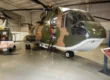
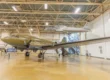
The Lightning is another of my favorites. It is located on the east end of the Hadley Gallery at the Hill Aerospace Museum. It is painted green on top to make it difficult to see from above, and grey underneath to blend with the sky.
By the standards of World War II aviation, the Lockheed P-38 Lightning looked like it came from the future. With its twin booms, central cockpit pod, and counter-rotating propellers, the P-38 was unlike anything else in the sky when it first flew in 1939.
To friend and foe alike, it was instantly recognizable. To its pilots, it was a paradox: demanding, temperamental, brilliant, and—when mastered—utterly lethal. This was not just a fighter. It was a long-range interceptor, an escort, a bomber destroyer, a reconnaissance platform, and an assassin’s blade that could reach farther than any other Allied fighter of its time.
Born of Urgent Necessity
When the United States entered World War I in 1917, it faced a stark reality – it had almost no trained military pilots. Glenn Curtiss’s answer was the JN series, a practical, forgiving aircraft designed to teach the fundamentals of flight safely and repeatedly. The JN-4D, the most famous and refined variant, quickly became the backbone of U.S. and Canadian flight training programs.
Powered by the dependable Curtiss OX-5 V-8 engine, producing around 90 horsepower, the Jenny was not fast, glamorous, or heavily armed—because it didn’t need to be. It needed to be predictable, repairable, and trustworthy. In those areas, it excelled.
A Radical Answer to a Radical Problem
In 1937, the U.S. Army Air Corps issued a requirement that sounded almost impossible: a high-altitude interceptor capable of extreme speed, heavy armament, and long range. Lockheed’s response, led by the legendary Clarence “Kelly” Johnson, ignored conventional wisdom entirely.
- Instead of one engine, Johnson gave it two.
- Instead of wing-mounted guns, he clustered all firepower in the nose.
- Instead of compromise, he chased performance at any cost.
The result was the XP-38, which stunned observers by exceeding 400 mph—unheard of for a fighter at the time. When the aircraft entered service as the P-38 Lightning, it became the only American fighter to remain in continuous production throughout the entire war.
Firepower Without Convergence
Most WWII fighters carried guns in the wings, requiring their bullets to “converge” at a set distance. The P-38 eliminated that limitation entirely. Its armament was concentrated in the nose:
- One 20mm Hispano cannon
- Four .50-caliber Browning machine guns
This meant every round flew straight ahead. At 300 yards or 800 yards, the Lightning hit exactly where it was aimed. Enemy pilots often reported catastrophic damage from what felt like a single, devastating burst.
In combat, the P-38 didn’t need to dance. It could line up, fire once, and end the fight.
Two Engines, One Mission – Reach
Range was the Lightning’s secret weapon. While early Allied fighters struggled to escort bombers deep into enemy territory, the P-38 could go the distance—especially over water. This made it indispensable in the Pacific Theater, where vast expanses of ocean separated targets by hundreds of miles. It wasn’t just effective there. It was dominant.
The Lightning was powered by two turbo-supercharged 1,600-horsepower engines. They powered counter-rotating propellers. This improved aircraft performance by eliminating torque effects, increasing efficiency, and eliminating “critical engine” issues. They balance propeller torque, reduce swirl, save roughly 6% to 16% on fuel, and provide more stable, straight-line airflow, increasing thrust efficiency.
Master of the Pacific Skies
In the Pacific, the P-38 found its ideal battlefield. Against lightly built Japanese aircraft, the Lightning’s speed, firepower, and dive performance were overwhelming. It could dive faster than its opponents, could follow, absorb punishment they couldn’t match, and disengage at will.
America’s top aces flew P-38s, including:
- Richard Bong, the highest-scoring U.S. ace with 40 victories. America’s “Ace of Aces” who flew the P-38 named Marge in the Southwest Pacific.
- Thomas McGuire, close behind with 38 in a Lightning named Pudgy
- Charles H. MacDonald, Commander of the 475th Fighter Group – 27
- Gerald R. Johnson, also with the 475th Fighter Group – 22
Laurence Elroy “Scrappy” Blumer
Captain Blumer named his P-38 Scrapiron. He lost three Lightnings in the first four months of combat. On August 25, 1944, he was flying Scrapiron IV when he was returning to base after leading a dive-bombing mission on three Luftwaffe airfields in northern France when he received a distress call from Major Grover Gardner, Squadron 394’s leader.
Gardner’s flight had been jumped by more than 40 Focke-Wulf Fw-190s approximately 25 miles away. Blumer quickly changed course and, with his wingman, Lieutenant Awtrey, climbed to 10,000 feet and plunged straight into the German swarm.
He scored his first kill with a 40-degree deflection shot. The hard-charging American continued to employ the same strategy of climbing and diving as more P-38s joined the fray. In the span of 15 minutes, Blumer shot down five enemy planes, making him an ace in a single mission.
Blumer’s wingman was a witness to the wild melee. He was watching for someone to jump Blumer. As the Nazis began to scatter, looking for safety in flight, Scrappy picked out the last remaining Jerry and dove on him like a hawk. “It was so fast I could hardly see it myself,” said Awtrey. “He peppered him with bullets, and the pilot went into a roll, and later I saw him bail out. When I look back on it now, it was like watching a movie.” Remarkably, Scrapiron IV returned to base without a scratch. “It was a pilot’s holiday,” said Blumer. “It was the sort of day a pilot dreams about and probably gets once in a lifetime.”
The 367th Fighter Group destroyed 25 enemy fighters and damaged 17 others in that violent air battle that raged for 40 minutes. Before finishing their mission, they destroyed a locomotive pulling 30 rail cars. For their efforts, the 367th Fighter Group received the Presidential Unit Citation, the highest possible award for a unit in combat. Of the 33 P-38s engaged, the Americans lost two pilots and had four others bail out over enemy territory. The Germans admitted to the loss of 16 airplanes, with 14 pilots killed, a disastrous loss for their unit.
The Yamamoto Intercept
Perhaps the Lightning’s most famous mission wasn’t an air battle at all. It was the Yamamoto Intercept. On April 18, 1943, a flight of P-38s executed one of the most precise and audacious missions of the war – the interception and killing of Admiral Isoroku Yamamoto, architect of the attack on Pearl Harbor.
Flying over 400 miles at wave-top height to avoid detection, the Lightnings arrived at the exact minute Yamamoto’s aircraft appeared. The ambush was swift and decisive. It was a surgical strike made possible by range, navigation precision, and an aircraft capable of executing it. No other fighter in the world could have done it.
The European Struggle
In Europe, the story was more complicated. Cold temperatures exposed flaws in early turbo-supercharger systems. High-altitude dive compressibility caused pilots to lose control—sometimes fatally—until improved dive-recovery flaps were introduced. Maintenance demands were higher than for single-engine fighters.
Yet, when properly handled, the P-38 excelled. It shot down German fighters, destroyed locomotives and armor, and served as a devastating ground-attack platform. Reconnaissance versions of the Lightning flew unarmed but uncatchable, bringing back intelligence that shaped entire campaigns. The aircraft didn’t fail in Europe—it demanded respect. Pilots who learned its quirks swore by it.
Legacy of a Legend
By war’s end, over 10,000 P-38s had been built. It was the first fighter to surpass 400 mph, the first with tricycle landing gear, and one of the most versatile combat aircraft of the entire conflict. The P-38 Lightning wasn’t easy. It wasn’t forgiving, and it wasn’t conventional. But it was brilliant.
In the hands of skilled pilots, it became a long-range executioner, a precision instrument of air power, and a symbol of American engineering audacity.
Even today, that unmistakable silhouette—the twin booms and central cockpit—still looks fast standing still. Some aircraft win wars by being simple. The P-38 Lightning won by being extraordinary.
How Hill Air Force Base made a difference
The P-38 on display at the Hill Aerospace Museum is the “J” variant. It is the fastest of the P-38s produced. Production began in 1943. During its time in service, the P-38 enjoyed several firsts –
- First fighter with speeds over 400 mph
- First fighter with tricycle landing gear
- First aircraft to employ power-boosted flight controls
- First turbo-supercharged fighter
- First American plane to use butt-jointed, flush-riveted, all-metal external surfaces
- First twin-engine interceptor to enter service in the US Army Air Corps.
Hill’s P-38 Legacy & Recovery
Even though P-38s were never stationed at Hill, the installation performed maintenance on these aircraft’s engines during World War II. The Lighting’s legacy as a formidable fighter lives on today. Hill Air Force Base is home to the US Air Force’s newest fighter aircraft, the F-35 Lightning II.
The aircraft on display was manufactured in 1943 and served with the 54th Fighter Squadron of the 343rd Fighter Group, on the island of Attu in the Aleutians. It crashed on 2 February 1945 on Buldir Island, where it remained for over 50 years until the Aerospace Heritage Foundation of Utah funded a recovery expedition.
The Hill Aerospace Museum acquired it for display in 1996 after the aircraft’s full restoration. Come and see this historic World War II aircraft in the Hadley Gallery. It is just one of the fascinating pieces of history on display.
Love finding local gems? Subscribe free to My Local Utah for Utah events, food, recipes and giveaways.
Business owners and event organizers: put your business, festival or event in front of Utah locals. List your business or advertise on My Local Utah.
Discover Utah Like Never Before — Subscribe FREE Today!
MY LOCAL UTAH is a locally owned platform committed to economic resilience, supporting local businesses and communities, and elevating the places and people that make our state remarkable. Whether you’re a lifelong resident or new to the Beehive State, we bring you closer to Utah’s heartbeat — the mom-and-pop shops, community events, hidden eateries, outdoor escapes, and small businesses that shape our everyday life.
Support local. Stay in the know. Live the Utah lifestyle.
When you subscribe for free, you’ll get first access to exclusive interviews, behind-the-scenes stories, seasonal events, curated itineraries, foodie features, and insider tips to help you explore Utah with purpose — while strengthening our local economy.
Be part of something meaningful.
Join the MY LOCAL UTAH community today because you uplift all of us when you support locals.
Subscribe now — it’s free!
Let’s build stronger communities, one story at a time.
Share the adventure!
Share The Love!