Share The Love!
The Sikorsky CH-3E Jolly Green Giant:
The Sound of Hope
By MyLocalUtah feature writer Lynn R. Blamires "Quadman"
The thunder of rotor blades over the jungles of Southeast Asia became a sound of hope during the Vietnam War. For stranded pilots, wounded soldiers, and isolated reconnaissance teams, few sights inspired more relief than the arrival of the towering Sikorsky CH-3E Jolly Green Giant. Built like a flying tank and painted in camouflage greens, the “Jolly Green Giant” became one of the most important combat support helicopters in American military history.
Not Merely a Helicopter, It Was a Lifeline
Derived from the civilian and naval Sikorsky S-61 design, the CH-3E and its combat rescue counterpart, the HH-3E, transformed how the U.S. Air Force approached battlefield rescue, troop transport, and special operations support. It was not merely a helicopter. It was a lifeline.
Born of a Need for a Heavy-Duty Helicopter for Hostile Environments
The origins of the CH-3E trace back to the early 1960s, when the U.S. Air Force needed a heavy-duty transport helicopter capable of operating in hostile environments. Sikorsky responded with rugged twin 1,500hp engines in an aircraft featuring a watertight amphibious hull, a rear-loading ramp, and enough lifting power to move troops, medical evacuees, or cargo deep into combat zones.
Evolution Into the HH-3E for Search and Rescue
What made the Jolly Green Giant truly legendary, however, was its evolution into the HH-3E combat search-and-rescue helicopter. These upgraded aircraft received armor plating, self-sealing fuel tanks, rescue hoists, machine guns, and one revolutionary capability that changed helicopter warfare forever: aerial refueling.
The First Military "Chopper" With Refueling Capabilities
For the first time in military aviation history, a helicopter could refuel in midair. That single innovation dramatically extended the aircraft’s range, allowing rescue crews to penetrate deep into enemy territory and remain on station for extended periods. During the Vietnam War, American pilots shot down over Laos or North Vietnam suddenly had a realistic chance of survival because the HH-3E could reach them where previous helicopters could not.
Its Importance in Ground Support Cannot Be Overstated
Unlike attack helicopters designed primarily to destroy enemy targets, the Jolly Green Giant excelled at sustaining combat operations and preserving lives. It transported troops into dangerous landing zones, evacuated wounded personnel under fire, delivered ammunition and supplies to remote outposts, and extracted reconnaissance teams from hostile territory. The aircraft could carry 25 combat-equipped troops, 15 litter patients, or roughly 5,000 pounds of cargo.
Jolly Green Crews Knew the Face of Danger
Its massive size and endurance also allowed it to coordinate with fighter escorts and airborne command aircraft during rescue missions. These operations often unfolded in some of the most heavily defended airspace in the world. Enemy anti-aircraft fire was relentless, yet Jolly Green crews repeatedly flew directly into danger to retrieve downed aviators.
Jolly Green Crews Were Highly Decorated
The bravery of those crews became legendary. During the Southeast Asia conflict, HH-3E aircrews earned one Medal of Honor, 24 Air Force Crosses, and more than 190 Silver Stars. Their missions embodied the Air Force rescue creed: “That others may live.”
The Famous Son Tay Raid
One of the helicopter’s most famous operations involved the attempted rescue of American prisoners of war during the 1970 Son Tay Raid. Though the prisoners had already been moved before the assault began, the mission demonstrated the extraordinary confidence military planners placed in the HH-3E and its crews.
Rescue of 28 Sailors From the Ta Lai
The Jolly Green Giant also proved its versatility outside combat. After Vietnam, the aircraft participated in maritime rescues, humanitarian missions, and even early support operations for the U.S. space program. During one dramatic 1979 rescue in the Yellow Sea, an HH-3E crew battled towering 15-foot waves and violent winds to save 28 sailors from the stranded Taiwanese freighter Ta Lai, earning the prestigious Mackay Trophy for the year’s most meritorious Air Force flight.
The Spirit Lives On in the HH-60W Jolly Green II
Technologically, the CH-3E represented a major leap forward in rotary-wing aviation. Its retractable refueling probe, amphibious capability, and long-range endurance paved the way for later rescue helicopters, such as the Sikorsky HH-53 Super Jolly Green Giant, as well as for modern combat rescue aircraft. Even today, the spirit of the Jolly Green lives on in the Air Force’s newest rescue helicopter, the Sikorsky HH-60W Jolly Green II, which carries the historic name into a new generation.
The CH-3E Jolly Green Giant at Hill AFB
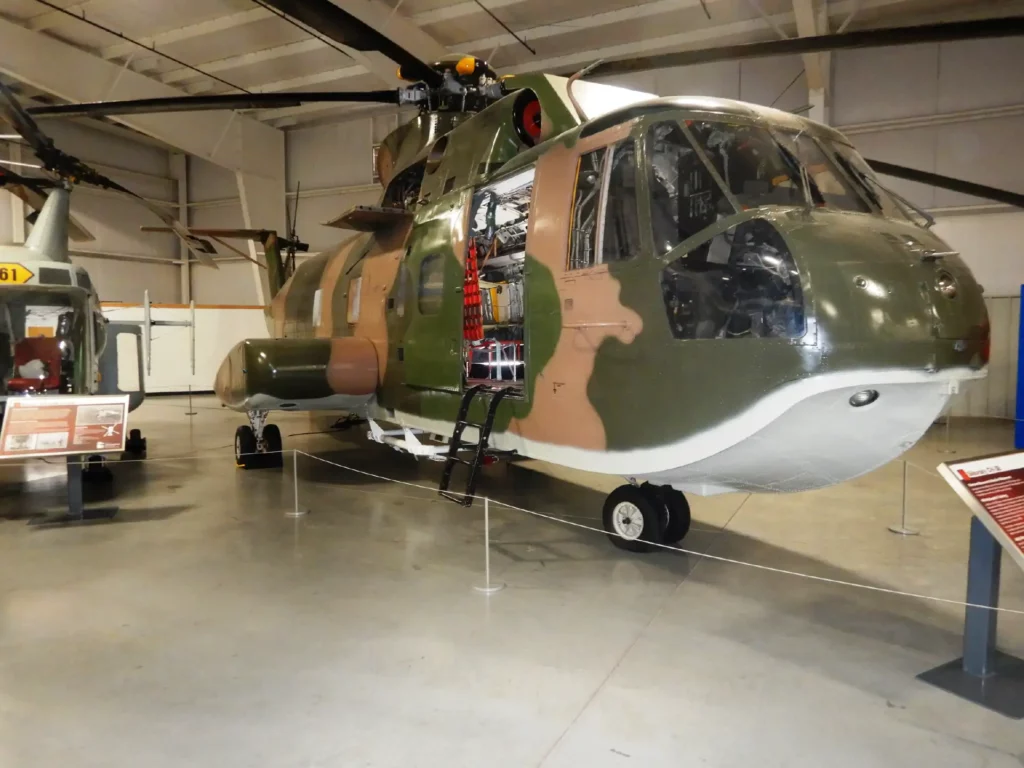
In 1973, all U.S. Air Force combat helicopter crews trained at Hill Air Force Base with the 1550th Aircrew Training and Test Wing. Hill instructors used 68 helicopters, 6 fixed-wing HC-130s, and simulators to train over 2,000 United States military members and foreign students in helicopter flying proficiency, including the CH-3E and H-53 Super Jolly. The 1550th was the largest tenant unit on base until it was transferred to Kirtland Air Force Base in New Mexico on March 15, 1976. The CH-3E on display served in Southeast Asia before being transferred to Hill Air Force Base, where it was fitted with a Mid-Air Recovery System to safely recover drones. In 1991, the aircraft was put on display at the Hill Aerospace Museum.
The Jolly Green: Key to Bringing People Home
More than sixty years after its first flight, the Sikorsky CH-3E Jolly Green Giant remains a symbol of courage, endurance, and battlefield compassion. In an era dominated by firepower and destruction, the Jolly Green crews represented something equally powerful: the unwavering promise that America would risk everything to bring its people home. Go stand under those rotor blades at the Hill Aerospace Museum and see for yourself. You can also read about the F-84 Thunderstreak and the museum’s Open Aircraft Day.
Quadman
Make It a Day Trip
The Hill Aerospace Museum is free to visit, open Tuesday through Saturday, and sits right off I-15 at the Roy exit. Start with a cup from Daily Rise Coffee on Antelope Drive in Layton, the locally owned drive-through Northern Utah has been waking up with for years, just up the road from the base. If you want a full breakfast, Scrambled! Breakfast + Lunch on Hill Field Road makes its eggs to order and gets the pancakes out fast enough to keep the kids happy. Then spend the morning with the Jolly Green Giant and its hangar-mates. If the museum runs into lunch, Warrens in Roy (mywarrens.com) has been flipping legendary burgers and shakes since 1955, and a Fiiz dirty soda on the way home never hurt anyone.

TEXT “WARRENS” to join 833-660-4964
Find more places to eat, shop and play around Hill Air Force Base in the My Local Utah directory. My Local Utah is published by 360 ELEVATED®, a Utah marketing agency that has spent 28 years telling stories for tourism and hospitality destinations and government agencies across the state.
Love finding local gems? Subscribe free to My Local Utah for Utah events, food, recipes and giveaways.
Business owners and event organizers: put your business, festival or event in front of Utah locals. List your business or advertise on My Local Utah.
Discover Utah Like Never Before — Subscribe FREE Today!
MY LOCAL UTAH is a locally owned platform committed to economic resilience, supporting local businesses and communities, and elevating the places and people that make our state remarkable. Whether you’re a lifelong resident or new to the Beehive State, we bring you closer to Utah’s heartbeat — the mom-and-pop shops, community events, hidden eateries, outdoor escapes, and small businesses that shape our everyday life.
Support local. Stay in the know. Live the Utah lifestyle.
When you subscribe for free, you’ll get first access to exclusive interviews, behind-the-scenes stories, seasonal events, curated itineraries, foodie features, and insider tips to help you explore Utah with purpose — while strengthening our local economy.
Be part of something meaningful.
Join the MY LOCAL UTAH community today because you uplift all of us when you support locals.
Subscribe now — it’s free!
Let’s build stronger communities, one story at a time.
Share the adventure!
Share The Love!