Share The Love!
Open Aircraft Day at the Hill Aerospace Museum
By Lynn R. Blamires
Thirteen historical war birds
Throughout 2025, I have been writing about fighter planes showcased in the Hill Aerospace Museum’s Fly-by-Fridays program. Each month, the spotlight has been on a warbird and the part it played in the wars in which the United States has been involved. September is different. Instead of highlighting one military aircraft, they are preserving the Hill Air Force base legacy by opening access to 13 historical war planes on one day.
Most significant event of the year
Open Aircraft Day is set for Saturday, September 20, the biggest event of the year for the Hill Aerospace Museum. Volunteers who have had personal experience in the cockpits of these aircraft will be on hand to answer questions and share those experiences with the public. The ropes will be pulled back, and access will be available for each airplane, giving you a view into the cockpit. In some cases, you will be able to walk into the bays of the huge cargo planes and helicopters.
Festivities will run between 9:00 and 4:00 p.m. and will be accompanied by Live music, food trucks, and Hill Air Force Base Unit Displays. Best of all, admission is free. Here is a run-down on the war birds that will be featured –
Douglas C-124C Globemaster II Old Shaky
Although officially the Globemaster II, the C-124 was unofficially and affectionately called “Old Shaky” because of its vibrating, rumbling passage through the air. Part of the reason was the four powerful Pratt & Whitney engines driving this huge aircraft. This engine is the largest-displacement, most powerful aviation piston engine in the United States, featuring 28 cylinders in a four-row radial design.
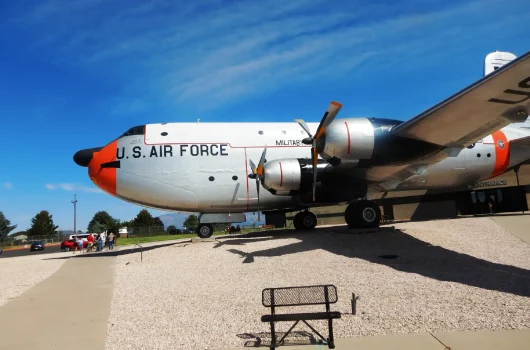
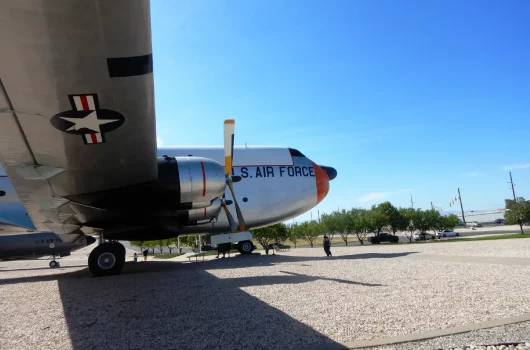


The Globemaster had one job.
Huge doesn’t begin to describe the size of this aircraft. Walk around it and see for yourself. It had one job – carry as much cargo as possible. The massive two-deck fuselage featured clamshell doors and a hydraulic ramp under the nose to accommodate loading cargo. Space within the C-124 was so extensive that large cargo such as tanks, bulldozers, cannons, and trucks was frequently carried inside the aircraft without needing disassembly. The C-124 at the Aerospace Museum received a facelift in preparation for Open Aircraft Day.
Boeing B-29 Superfortress Known for dropping the Fat Man
Most remembered for its role in ending World War II by dropping the Fat Man atomic bomb on Nagasaki in 1949, the B-29 was the most sophisticated propeller-driven bomber of World War II and the first bomber to house its crew in pressurized compartments. It was designed to replace the B-17 and the B-24.
B-29 is heavily armed
The B-29 carried eight .50-cal machine guns in remotely controlled turrets, two .50-cal. machine guns and one 20mm cannon in a tail turret, and up to 20,000 pounds of bombs. The “Enola Gay” was the name of the plane on the mission to Japan. “Straight Flush” adorns the B-29 inside the Aerospace Museum.
Douglas VC-47D Skytrain The “Gooney Bird”
Few aircraft are as well-known, as widely used, or as long-lived as the C-47. Affectionately nicknamed the “Gooney Bird,” this aircraft was adapted from the Douglas DC-3 commercial airliner. These C-47s carried personnel and cargo around the globe. They also towed troop-carrying gliders, dropped paratroops into enemy territory, and air-evacuated sick or wounded patients.
It looks like a DC-3
After World War II, many C-47s remained in U.S. Air Force service, participating in the Berlin Airlift and other peacetime activities. During the Korean War, C-47s hauled supplies, dropped paratroops, evacuated wounded, and dropped flares for night bombing attacks. The DC-3 was the first aircraft to make civilian passenger travel reliable and profitable, with the C-47 proving equally trustworthy in military service.
Convair T-29C Flying Classroom
The T-29C was designed as a specialized training aircraft, teaching navigators and bombardiers for all types of U.S. Air Force aircraft. Each trainer aircraft contained sixteen stations for airborne instruction, including access to a map table, equipment used for lang-rang navigation, altimeters, a radio compass panel, and other essential instruments. It was also equipped with “astrodomes” to provide students with a view of the stars for celestial navigation.
I took my first flight in the civilian version.
It was derived from the civilian Convair CV-240. My dad worked as an instrument mechanic at American Airlines when I was a boy. We had flying privileges because of his employment there, and I had my first flight in one of these planes.
Lockheed C-140B JetStar Air Force One
The US Air Force purchased 17 of these jet transports, intended initially for civilian use. Six of them flew on special government and White House airlift missions. In 1992, the Hill Aerospace Museum acquired the aircraft. At the time, museum staff had no idea the plane had served as Air Force One for President Lyndon B. Johnson and First Lady Claudia Taylor “Lady Bird” Johnson.
When museum staff first received this JetStar, the paint scheme had nothing on it to indicate the true nature of its prior service. As the restoration crew sanded down layers of paint during restoration, they discovered a shadow of the presidential seal. Further research on the original tail number brought to light its prior service as President Johnson’s jet.
Lockheed SR-71C Blackbird Known for its speed records
One of the most recognizable aircraft in the US Air Force, the SR-71 was a long-range, strategic photo-reconnaissance aircraft that first took flight during the Vietnam War. The SR-71 is best known for its world record speeds, many of which were set without pushing its full capabilities. From 80,000 feet, these aircraft could survey 100,000 square miles of the earth’s surface per hour. The aircraft’s unique design enables it to reach the mind-blowing speeds that have made the Blackbird famous.
This Blackbird is a one-of-a-kind.
The aircraft on display was the only “C” model Blackbird built and, in 1968, was the last SR-71 manufactured. It earned its nickname, “The Bastard,” since it included the rear fuselage of a YF-12A and the forward fuselage of an SR-71A.
Faster than a speeding bullet
A bullet fired from an AK-47 rifle travels at 1,360 mph—and the Blackbird traveled much faster. On 28 July 1976, an SR-71 set a world record at almost twice that speed, clocking in at 2,193.167 mph! It was able to fly from Washington, DC, to Los Angeles in just over one hour. On the same flight, it also set an altitude record of 85,068.997 feet or 16 miles above ground, making the SR-71 the world’s fastest and highest-flying manned aircraft.
North American L-17 Navion Personal plane of former Senator Jake Garn
The L-17 was used for liaison, reconnaissance, light cargo, and some as target drones. This Navion was the personal plane of former Utah Senator Jake Garn, an accomplished and seasoned pilot. Senator Garn is the only pilot in history to have aviation wings from the US Navy, US Air Force, and NASA.
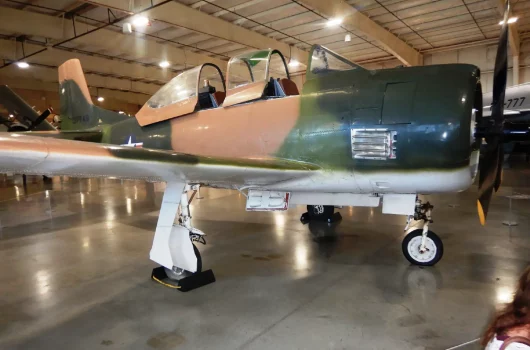
North American T-28B Trojan The Trojan replaced the Texan
The T-28 replaced the aging World War II-era T-6 Texan. The new design was a far more powerful trainer than any previously built and was the first United States military trainer to use tricycle landing gear and a hydraulically boosted, steerable nose wheel. An 800-horsepower engine powered the early Air Force version, while later models utilized a 1,425-horsepower engine.
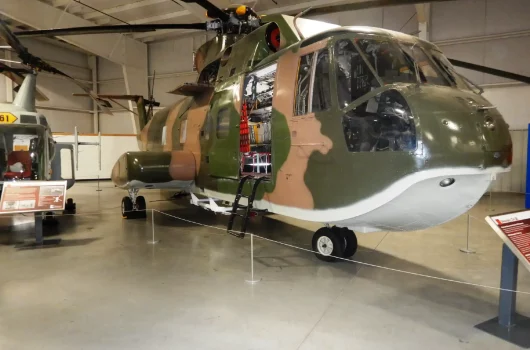
Sikorsky CH-3E The “Jolly Green Giant”
During the Vietnam War, the US Air Force used the CH-3E for troop, cargo, and medical transport. The CH-3E could carry either 25 fully equipped troops, 15 patients on stretchers, or 5,000 pounds of cargo.
Many CH-3Es were modified for combat rescue missions with armor, self-sealing fuel tanks, a rescue hoist, and in-flight refueling capability. They were redesignated HH-3Es and used extensively in Vietnam under the nickname “Jolly Green Giant.”
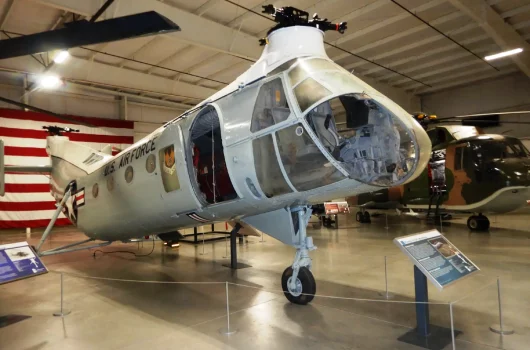
Piasecki CH-21C Workhorse/Shawnee
Commonly called the “Flying Banana”, the Shawnee was a multi-mission helicopter, utilizing wheels, skis, and floats. The design lent itself to the Flying Banana name. To prevent interference between the tandem counter-rotating blades, they were set at angles – hence, this chopper looked like a banana. It saw extensive service in Vietnam.
Designed for severe cold-weather use
Developed initially as an Arctic rescue helicopter. The H-21 had winterization features permitting operation at temperatures as low as -65°F, and could be routinely maintained in severe cold weather environments. It performed poorly in the hot weather of Vietnam. Despite being capable of carrying 20 passengers, it only carried 9 when operating in Vietnam. The Shawnee continued in service as the U.S. Army’s helicopter workhorse in Vietnam until 1964.
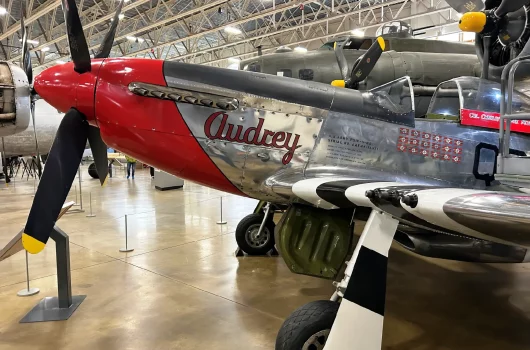
P-51 Mustang The British made it better.
The P-51 Mustang began as a British-requested design by North American Aviation in 1940, initially powered by an American-built Allison V-1710 engine. Replaced with a Merlin engine, the P-51D became a highly effective high-altitude fighter.
One of the finest fighters of World War II
The D model featured a new bubble canopy for greatly improved pilot visibility, a feature highly requested by those who flew them. The P-51 Mustang is considered one of the finest fighters of World War II and is celebrated for its performance and sleek design. The P-51 Mustang and the achievements of its pilots, including the Tuskegee Airmen, remain an integral part of aviation and military history.
A-10 Thunderbolt/Warthog Known for its 30mm Gatling gun
Affectionately called the “A-10 Warthog” for its aggressive look and often painted with teeth on the nose cone, the A-10 Thunderbolt II is the U.S. Air Force’s primary low-altitude close air support aircraft. The A-10 is perhaps best known for its fearsome GAU-8 Avenger 30mm Gatling gun mounted on the nose. The GAU-8 is designed to fire armor-piercing depleted uranium and high-explosive incendiary rounds.
Highly accurate
The A-10 Thunderbolt II has excellent maneuverability at low air speeds and altitude, and is a highly accurate and survivable weapons-delivery platform. The aircraft can loiter near battle areas for extended periods of time and operate in low ceiling and visibility conditions. The wide combat radius and short takeoff and landing capability permit operations in and out of locations near front lines. Using night vision goggles, A-10 pilots can conduct their missions during darkness.
And survivable
A large bubble canopy provides excellent vision, and titanium armor protects the pilot and parts of the flight-control system. The aircraft can survive direct hits from armor-piercing and high-explosive projectiles up to 23mm. Their self-sealing fuel cells are protected by internal and external foam. Manual systems back up their redundant hydraulic flight-control systems. This permits pilots to fly and land when hydraulic power is lost.
F-16 Fighting Falcon Used by over 25 air forces worldwide.
A single-engine, multi-role fighter jet known for its superior maneuverability, all-weather capability, and versatility in both air-to-air combat and air-to-surface attack missions, the F-16 has been used by over 25 air forces worldwide. It remains a mainstay in aerial combat fleets for the US and its allies and is one of the most successful military aircraft ever built.
The fly-by-wire system
The F-16’s fly-by-wire (FBW) system is significant because it was the first ever installed on a production fighter aircraft and made possible a new, high-performance design philosophy known as “relaxed static stability”. This revolutionized fighter agility and is now a standard feature on nearly all modern combat jets.
It makes an intentionally unstable aircraft flyable.
The most essential function of the FBW system is to make an intentionally unstable aircraft flyable. Unlike previous aircraft designed to be naturally stable (like a dart) and return to straight-and-level flight, the F-16 was built to be slightly unstable. Its center of gravity is positioned behind its aerodynamic center, giving the airframe a natural tendency to pitch and roll.
The flight computer makes thousands of adjustments per second.
This instability means the F-16 is constantly on the edge of controlled flight, requiring less energy and smaller control surface movements to initiate a turn or change direction. The flight control computer (FCC) constantly makes thousands of adjustments per second to the control surfaces to maintain straight flight. When the pilot provides input, the computer translates the command into precise control surface movements that make the plane more responsive and agile than earlier fighters.
These 13 aircraft will be showcased at Open Aircraft Day at the Hill Aerospace Museum on Saturday, September 20, 2025. Enjoy the day among these famous war birds.
Make your own adventure on the Arapeen
The ride back to Ferron is a story for another day. When you go, take plenty of water, keep the rubber side down, and get a map of the Arapeen Trails to make your own ATV adventure.
EXPLORE MY LOCAL UTAH
My Local Utah is your one stop destination for everything Utah. Whether you’re a business owner looking for resources, a resident looking to explore hidden gems, or a visitor eager to experience Utah’s unique culture and offerings, we’ve got you covered.
Share the adventure!
Share The Love!