Share The Love!
The B-25 Mitchell:
The Medium Bomber That Could Do Almost Anything
By MyLocalUtah feature writer Lynn R. Blamires "Quadman"
There are a lot of airplanes on display in the Hill Aerospace Museum, and every warbird has a story. I have loved reading about their stories since I was a kid. Walking through the galleries where they stand is an awesome experience. One I would like to focus on is the North American B-25 Mitchell.
There are warplanes that win with elegance, and then there are warplanes that win with attitude. The North American B-25 Mitchell wasn’t built to be pretty. It was built to work, to take punishment, haul a meaningful load, fly from dirt strips, and still come home with the kind of scars that earned respect on the ramp. It was the aircraft equivalent of a hard-nosed sergeant: not flashy, not fragile, and absolutely not interested in excuses.
And yet, despite its no-nonsense design, the B-25 would become one of the most famous aircraft of World War II. Not because it was the biggest bomber. Not because it was the fastest. But because it was the bomber that could do almost anything, anywhere, and it did it with a reliability that made crews trust it like a teammate.
A Bomber Named for a Fighter
The B-25 is named after General Billy Mitchell, a firebrand advocate of airpower long before the world took bombers seriously. The name fits.
Because the Mitchell didn’t behave like a typical “medium bomber.” It behaved like a fighter with a payload: quick to respond, surprisingly agile, and capable of low-level aggression that most bombers wouldn’t dare attempt.
North American Aviation designed the B-25 in the late 1930s, and by the time America entered the war, it was ready for mass production. It would go on to become one of the most-produced American bombers of WWII, with nearly 10,000 built, and those aircraft served across almost every major theater of the war.
The Doolittle Raid: The Moment the Mitchell Became a Legend
If you know one story about the B-25, it’s about sixteen B-25s that took off from an aircraft carrier. Not fighter planes. Not dive bombers. Not torpedo planes. Full-sized twin-engine medium bombers, loaded, fueled, and committed.
It was the first and only time that bombers had been launched from a carrier, and they achieved complete surprise when they reached their objectives. The material damage they inflicted was slight, but the raid had a major psychological impact.
On April 18, 1942, the aircraft carrier Hornet launched 16 North American B-25 bombers on a mission to attack the Japanese mainland in retaliation for the devastating surprise attack on Pearl Harbor. The plan was to get within 400 miles of Japan to ensure maximum success. However, the task force was discovered 650 miles offshore. Fearing the potential threat of Japanese land-based air assets, Admiral Halsey ordered the early launch of Doolittle’s bombers.
It took a little over an hour before the last B-25 left the deck of the Hornet. Carrying high-explosive and incendiary bombs, the raiders flew on and hit targets in Tokyo, Yokosuka, Yokohama, Kobe, and Nagoya, against negligible opposition. Of the 16 B-25s, 15 crashed in occupied China, and one landed intact at Vladivostok, where the Soviets interned the aircraft and its crew. Despite the loss of these 15 aircraft, 69 airmen escaped capture or death, with only three killed in action.
It was bold, risky, and strategically priceless. Not because of the damage inflicted, but because it proved something vital: America could reach Japan. The psychological impact hit like a bomb all its own.
Built for War: Tough, Practical, and Brutally Effective
The B-25’s layout was classic WWII bomber thinking: twin engines, mid-wing design, tricycle landing gear (a major advantage for visibility and ground handling), and a roomy fuselage adaptable to different missions. But what made the Mitchell special wasn’t just the blueprint. It was rugged.
The Human Side: Why Crews Loved It
There’s a reason you still hear affection in veteran accounts of the B-25. In a war full of machines that demanded everything from the people inside them, the Mitchell had a reputation for being stable, forgiving, reliable, combat-tough, and easy to maintain. Those qualities are solid survival traits.
The B-25 gave crews a fighting chance. The B-25 could absorb damage and still fly. Many returned with shredded control surfaces, holes in their wings, and missing chunks of their tails, yet kept crews alive. “It is amazing how much punishment the B-25s could take,” said Lieutenant David Hayward, a pilot with the 341st Bomb Group based in India and the Pacific. “There were relatively few vulnerable places on the airplane. We had an armor plate under our seats. The gasoline tanks were self-sealing. What we sacrificed in speed we gained in security.”
One B-25C of the 321st Bomb Group was nicknamed “Patches” because its crew chief painted all the aircraft’s flak hole patches with bright yellow zinc chromate primer. By the end of the war, this aircraft had completed over 300 missions, had been belly-landed six times, and had over 400 patched holes. The airframe of “Patches” was so distorted from battle damage that straight-and-level flight required 8 degrees of left aileron trim and 6 degrees of right rudder, causing the aircraft to fly sideways across the sky.
The B-25 Was Adaptable
The B-25 wasn’t locked into one job description. It could bomb from altitude, skim treetops, hunt ships, strafe airfields, and serve as a gunship. The B-25’s most savage evolution was the strafer and gunship variants.
In the Pacific War, the jungles and island chains of the South Pacific often made high-altitude bombing ineffective. Targets were small, mobile, and protected by terrain. The answer was a low-level attack.
So, crews and engineers turned the B-25 into a flying battering ram. The B-25G and H variants had a 75mm cannon in the nose, the same caliber you’d find on armored vehicles and anti-tank guns. The cannons were hand-loaded by the navigator/cannoneer and were highly effective against ships and barges.
Many Mitchells were packed with forward-firing .50 caliber machine guns, enough to turn the aircraft into a strafing platform that could shred trucks, buildings, parked aircraft, and anything unlucky enough to be in its line of fire. In these forms, the B-25 wasn’t just a bomber. It was a warplane with range and reach.
The Mitchell was the bomber that could be:
- a precision attacker
- a low-level striker
- a gunship
- a ship killer
- a morale weapon
- a workhorse
And in World War II, versatility wasn’t a luxury. It was victory.
The Mitchell Fought Across All Theaters of War
- Pacific Theater: island hopping, anti-shipping, jungle strikes
- North Africa & Mediterranean: interdiction, supply disruption, tactical bombing
- China-Burma-India: brutal long-range operations in harsh terrain
- Europe: medium bomber missions and support operations
It didn’t need perfect runways or perfect weather. It just needed fuel, ammunition, and a crew willing to go to work.
Hill AFB Support for the B-25
During World War II and the post-war era, Hill Air Force Base provided critical support for the B-25 Mitchell bomber by performing engine overhaul, maintenance, and structural repairs on the aircraft. Additionally, the base served as a storage facility for surplus B-25s, which were later rehabilitated and returned to service for training and transport. The base’s efforts to maintain, store, and rehabilitate B-25s ensured that these versatile aircraft remained available for service beyond the main combat years of World War II.
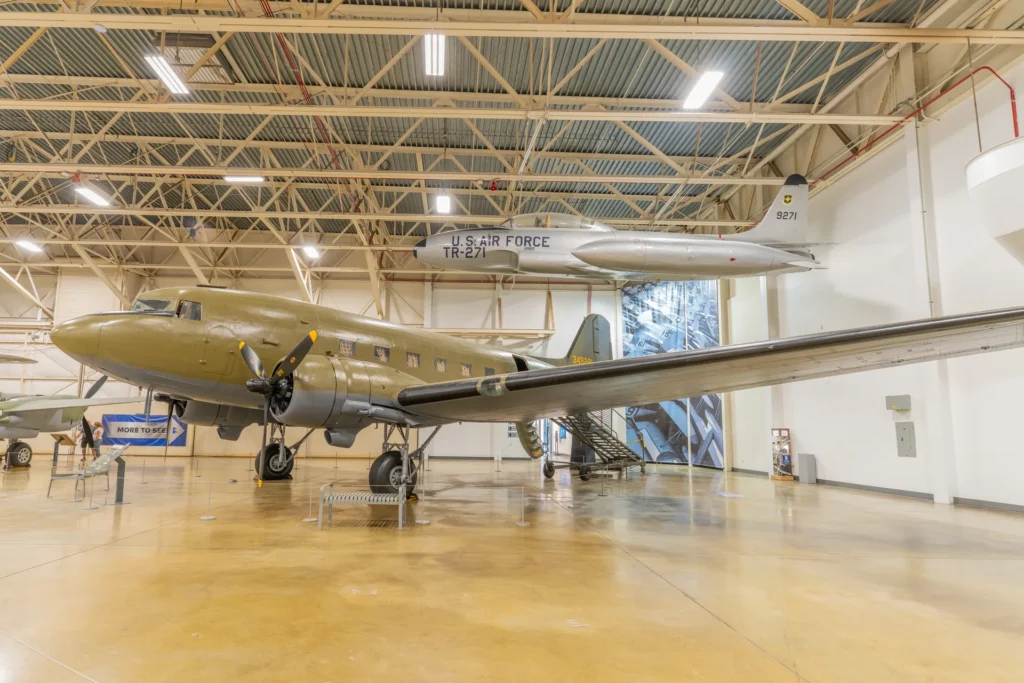
Come and See the B-25 Mitchell
The Hill Aerospace Museum is fortunate to have one of these historical planes, which played a huge role in securing our country’s freedom. The B-25 on display is the “J” variant. This model was designed to be a gunship. It is bristling with eight .50-caliber machine guns in the nose, with four more mounted, two on each side, all pointing forward and controlled by the pilot.
It also became an excellent skip bomber. Just as you can skip rocks across a pond, the B-25J would come in low, skimming the water on a strafing attack on an enemy ship, and drop its bombs. The bomber’s forward motion would cause the bombs to skip along the water’s surface, penetrating the ship at the waterline. A delayed fuse on the bombs would set them off after penetration, sinking the ship in short order.
Every warbird has a story. You can learn more about the story of the historic North American B-25J at the Hill Aerospace Museum. Come and see it in the Hadley Gallery. While you’re there, look for the F-84 Thunderstreak and the other warbirds we’ve featured, and check the museum’s Open Aircraft Day schedule.
Quadman
Make It a Day Trip
The Hill Aerospace Museum is free to visit, open Tuesday through Saturday, and sits right off I-15 at the Roy exit. Start with a cup from Daily Rise Coffee on Antelope Drive in Layton, the locally owned drive-through Northern Utah has been waking up with for years, just up the road from the base. If you want a full breakfast, Scrambled! Breakfast + Lunch on Hill Field Road makes its eggs to order and gets the pancakes out fast enough to keep the kids happy. Then spend the morning with the B-25J and its hangar-mates. If the museum runs into lunch, Warrens in Roy has been flipping legendary burgers and shakes since 1955, and a Fiiz dirty soda on the way home never hurt anyone.
Find more places to eat, shop and play around Hill Air Force Base in the My Local Utah directory. My Local Utah is published by 360 ELEVATED®, a Utah marketing agency that has spent 28 years telling stories for tourism and hospitality destinations and government agencies across the state.
Discover Utah Like Never Before — Subscribe FREE Today!
MY LOCAL UTAH is a locally owned platform committed to economic resilience, supporting local businesses and communities, and elevating the places and people that make our state remarkable. Whether you’re a lifelong resident or new to the Beehive State, we bring you closer to Utah’s heartbeat — the mom-and-pop shops, community events, hidden eateries, outdoor escapes, and small businesses that shape our everyday life.
Support local. Stay in the know. Live the Utah lifestyle.
When you subscribe for free, you’ll get first access to exclusive interviews, behind-the-scenes stories, seasonal events, curated itineraries, foodie features, and insider tips to help you explore Utah with purpose — while strengthening our local economy.
Be part of something meaningful.
Join the MY LOCAL UTAH community today because you uplift all of us when you support locals.
Subscribe now — it’s free!
Let’s build stronger communities, one story at a time.
Share the adventure!
Share The Love!